
Not long ago, I was in a conversation with a veteran social studies teacher preparing a lesson on Reconstruction who asked me a question they would not have had to previously. They were not asking if the lesson aligned to standards. They were not asking if it would engage students. They were asking if it would cause a problem. That question stayed with me.
Because it signals something has already shifted. The work has not changed, but the conditions around the work have. That shift does not announce itself directly. It shows up in hesitation. It shows up in what people decide not to do. It shows up in the extra step of asking whether something that should be routine is now a risk. I spend a lot of time working with teachers on curriculum and instruction. What has changed is not just what we are teaching. It is how people are thinking about teaching it. There is a level of calculation that did not use to be there in the same way. People are weighing what is worthwhile against what is sustainable. Those are not the same question.
I do not think this is new. When I look at earlier periods, especially after Reconstruction and after the Civil Rights Movement, there were similar moments where progress did not disappear, but it was adjusted. Access remained, but the terms shifted. The system did not reject what had been gained. It absorbed it and reshaped it. Because of that, when I look at current decisions that have undermined the Voting Rights Act of 1965, I do not read them as isolated legal changes. They affect who has influence and what becomes possible in schools.
The same is true when I think about ongoing questions around Temporary Protected Status. There are students sitting in classrooms whose families are directly affected by those decisions. That is not abstract. That is a student trying to focus while their sense of stability is uncertain. So when people talk about separating policy from practice, I do not find that useful. The separation is not real.
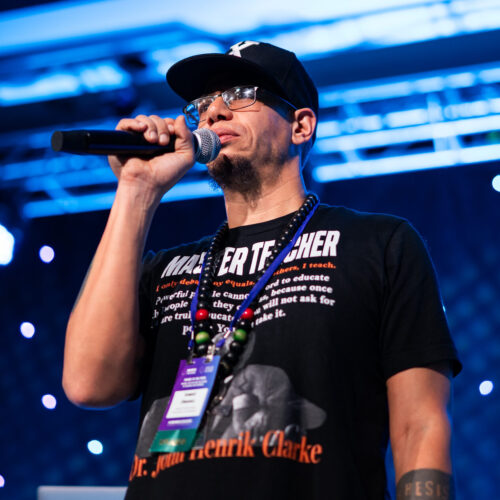
I was reminded of that in recent conversations with other leaders at an Education Leaders of Color (EdLoC) conference. The specifics varied depending on the city, but the patterns were consistent. People spoke about shifts in funding, increased pressure around how equity work is framed, and a growing need to be more deliberate about language. There was also a shared sense that the work is becoming more isolating, even as the need for it becomes more urgent. What stood out to me was not just the challenges themselves, but how people were adjusting in response. Building stronger coalitions. Thinking more carefully about how to move work forward without drawing unnecessary attention to it. Finding ways to sustain efforts that cannot rely on a single policy or decision holding in place.
I think about Derrick Bell here because he named something that shows up in the day-to-day. Changing rules does not necessarily change the conditions that produced the problem. I see that when a curriculum is technically approved, but teachers still feel the need to soften language before using it, or when a lesson that centers Black history is followed by a request to “provide balance,” even when the standard itself calls for depth. Nothing has been formally taken away, but the terms have shifted enough to change how the work is carried out. But over time, it narrows what people are willing to do.
Students are still showing up every day. They are not experiencing this as a policy discussion. They are experiencing it in what they are asked to learn, how they are asked to think, and whether what they bring into the classroom is recognized. That does not leave room to step back from the work. But it does require being more deliberate about how the work is done. Not everything can depend on a system holding in place. Some of the most important decisions happen in ways that are easy to overlook. How a teacher frames a question. What gets included without hesitation and what gets second-guessed. Whether a student’s perspective is taken up or redirected.
Those decisions accumulate. I think about that as planting seeds, but not in a way that assumes they will all grow. Some of them will not. Some will be interrupted. That is part of the reality of the moment. But choosing not to plant them is also a decision. And I am not willing to treat that as a neutral one. So the work continues, not because the conditions are stable, but because they are not. And waiting for them to be is not an option.