A love letter to the young people we’re inviting into the classroom
To the young person reading this — whether an auntie sent it to you, a Teaching Academy instructor put it in front of you, a scholar-teacher from our Freedom Schools Literacy Academy (FSLA) shared it, or you found it on your own — this is for you.
Our invitation to youth to consider leading classrooms of your own is grounded in Black teaching frameworks and pedagogy and in African-centered community values. One of those values, said plainly: we train and develop our replacements. That is a promise, and it is how we honor you — by telling you, out loud, that we are preparing those interested, to carry what we carry – in education and in our communities. It comes from decades of work in city schools and years of national organizing around one belief: that when Black children have Black teachers, everything is possible.
it is to know that the students in front of us today are the solutions to current and future challenges. Not the problems to be managed. The solutions. We are looking at future teachers, principals, superintendents, policy writers, school board members, and ancestors — and we want, no, we need, you ready.
There is a Native American proverb: we do not inherit the earth from those who came before us; we borrow it from those who come after. The earth is not our inheritance. It is a loan, and we return it in better condition than we found it, or we have not been honest borrowers.
Classrooms, schools, and districts are like that too. We borrow them from the children who have not walked through the doors yet, and by leading them well, we return what we borrowed in far better condition than it was handed to us. That is a weighty promise, and it shan’t be broken.
Why we want you specifically
We want you in the classroom because we have been paying attention to the block, the country, and the archives for a long time. We know what happens when Black children have Black educators who love them, know them, and expect the world of them — in the neighborhoods, in the graduation lines, in the test scores, in the lives those children build two generations later. We also know what happens when that mirror is missing.
You are not being invited into teaching as a fallback. You are being invited the way earlier generations were invited into the ministry, into medicine, into the trades that built neighborhoods — as one of the most consequential things a person can do with a life. Teaching is career and technical education. Teaching is skilled labor. Teaching is intellectual, community, and spiritual work. Done right, it is the closest thing we have to time travel and it represents the purest form of activism.
And teaching is leading. A teacher runs a classroom of twenty-five to thirty human beings (at least) every day. A teacher sets the tone, sets the standard, decides what gets taught and what gets skipped, decides which child gets challenged and which child gets protected, decides what is worth arguing about and what is worth letting go. That is leadership. When people talk about leadership without talking about teaching, they are missing the most consequential leadership happening in any society.
As educators, we are caretakers of a sacred space. And that space is yours. Yours to learn in, yours to lead in — a learning environment you help shape from the day you step into it.
The young people who told researchers what they need said it plainly: they want teachers with agency in their own classrooms. Students already know teaching is leading. They are watching to see whether we will let teachers lead. We are asking you to be one of the ones who does.
The arc of influence
Before we get to the classroom, think about how any of us actually learned anything worth learning. Apps did not do it. Textbooks by themselves did not do it. People did. An older cousin who taught us to ride a bike, a grandmother who taught us how to season food and hold our head when we walk into a room, a neighbor who taught us to shoot a jump shot or sit still through a hard conversation, a mentor who taught us how to leave a job with our dignity intact. Every one of us can name a handful of people who taught us how to be in the world, and most of them were not paid to do it.
And if we are being honest, we also taught them. We taught our grandmothers how to work a phone. We taught our elders about what young people were actually going through, and in doing so, we widened their aperture and shrank their blind spots. Not one direction, but two. Not one generation talking at another, but generations teaching each other.
A classroom is a formal version of that — the oldest human tradition, with training and structure added so that the exchange reaches more children more reliably, and so that no child is left out even if their family did not have a cousin, a grandmother, a neighbor, or a mentor in the right place at the right time.
When apprentice teachers come to us through Teaching Academy, the Future Teachers of Excellence Fellowship, and/or the Freedom Schools Literacy Academy, we say something to them on the first day that we want you to hear too. Your impact during your clinical experience is not just about the child in front of you.
It is about that child’s grandchildren.
Because the eight-year-old you are teaching this summer will one day be somebody’s parent. And then somebody’s grandparent. What you plant in that child — the confidence, the love of reading, the belief that they are brilliant, the memory of the teachers who saw them — becomes what that child passes down to their own children, who pass it down to theirs. Three generations from one summer. A whole family tree bent by one educator who decided the child in front of them was worth their whole self.
This is why self-efficacy, agency, and mindset matter most of all in this profession — more than any curriculum, pacing guide, or evaluation rubric. A teacher who does not believe they can change the arc of a family will not change it. A teacher who knows they can teaches differently on Monday morning than a teacher who thinks they are only there to cover a standard.
You will be teaching people you never meet. Grandchildren you will never hold. Communities you will never visit. That is the weight of the work, and the joy of it.
Those same young people told researchers what pulls them toward teaching is the chance to build strong relationships and make a difference for future generations. They already know the arc. What they are waiting on is the invitation, the pathway, the support, and honest talk about what the work asks and what it gives back.
We are inviting you. And we are already building the year-round high school pathway into teaching that gets you ready to lead a classroom of your own — mentorship, coursework, college credit, and the Le Count – Catto Curriculum grounded in Black pedagogy. Complete the pathway and the college scholarships, coaching, and retention bonuses that follow are yours to claim.
The hands go up
Ten years ago, through The Fellowship: Black Male Educators for Social Justice — the organizing home that grew into the Black Men in Education Convening and into the Center for Black Educator Development — we ran the Why I Teach Tour: A Rising Era of Educators for Social Justice. Panels of Black male teachers went into schools across Philadelphia and around the country, asking a simple question: who in here is thinking about becoming a teacher?
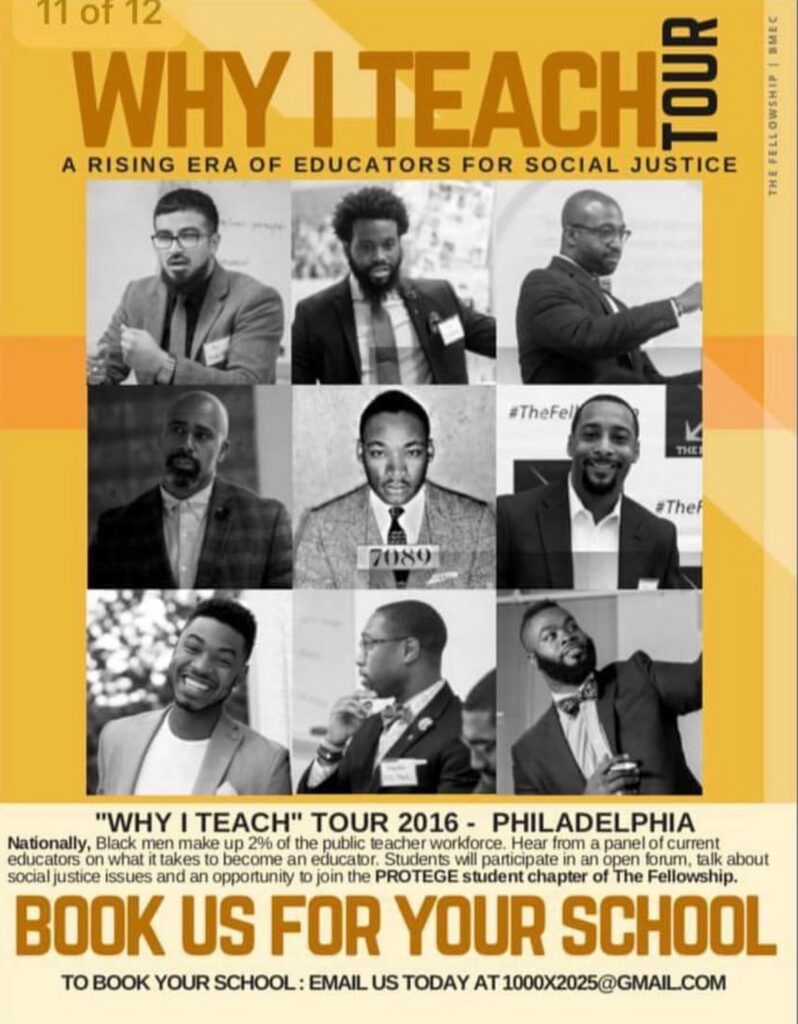
In most rooms, most hands stayed down.
Then we would talk about teaching as leadership. As deciding what a generation of children learns and what they miss. As the work that produces every other profession — the doctor’s teacher, the lawyer’s teacher, the engineer’s teacher, the president’s teacher.
Then we would ask again. And the hands went up. Hands from young people who had never once been told that what they were being asked to consider was leadership.
That is the story of this invitation, in one gesture. The interest was already there. What was at times missing was the frame. A decade later, over a hundred young Black men (and hundreds of young Black women) are exploring teaching through a program that has proven its ability to convert their interest into actionable plans, and so many teachers, principals, and program leaders are here with you working alongside of us to rebuild a national Black Teacher Pipeline.
So many have raised their heads and hands to lead. Will you raise yours?
What “replacement” actually means
“We train and develop our replacements” scares some people. It should not scare you. It should honor you.
It means we are not building careers around ourselves. We are building a bench. What took us twenty and thirty and forty years to learn, we hand over so you do not have to learn it the hard way. The notes are yours, the mistakes we made are yours to study, and the traps are yours to see coming.
We are not asking you to carry what we carry so you can become us. We are asking you to carry it so you can be smarter, stronger, more aware, with better eyesight and better foresight than we had. Use the lessons we taught you. Use the lessons we endured. And then do it better than we did. That is the whole point of handing anything down.
The elders who taught us did the same. Some are still with us, some are ancestors now, and all of them expected to be replaced — and improved on. Refusing to be replaced is how a movement dies. Preparing your replacement, and ensuring they can surpass you, is how it keeps going long after any one of us is gone.
What our teachers told us
At the start of each school year, the best teachers we ever had said something like this: I will only be successful if you are successful, and you will be successful if I am, and all of that depends on us being successful together. They were not managing a classroom. They were building a community, telling children and youth that on day one that we were tied to each other, and our fates would rise or fall together.
We still carry that. It is why we are asking you to become the one who says it to the next group of youth and children.
What Gwendolyn Brooks said
Gwendolyn Brooks, one of our community’s Poet Laureates, wrote a poem for Paul Robeson. Mama Fasaha just posted it and I cherished the memory of it. Read it slowly. Read it out loud if you can. The last three lines are the ones we especially want you to carry with you.
That time
we all heard it,
cool and clear,
cutting across the hot grit of the day.
The major Voice.
The adult Voice
forgoing Rolling River,
forgoing tearful tale of bale and barge
and other symptoms of an old despond.
Warning, in music-words
devout and large,
that we are each other’s
harvest:
we are each other’s
business:
we are each other’s
magnitude and bond.
that we are each other’s
harvest:
we are each other’s
business:
we are each other’s
magnitude and bond.
We are each other’s harvest. What we planted is you. What you plant will be the ones who come after you. Nobody harvests alone, and nobody is here alone.
We are each other’s business. Your education is our business. Our elders are your business. The children who will be in your classroom in ten years are already our business, and they will be yours. There is no such thing as somebody else’s child.
We are each other’s magnitude and bond. Your greatness is tied to ours, and ours to yours, and both of ours to the greatness of the ones we have not met yet. That is why we do not get to quit on each other, and why we train and develop our replacements.
What we are asking
Come teach.
Come teach even though the pay fight and the policy fights are not finished. Come help us finish them, because the children in front of you cannot wait, and they should not have to.
Come teach because somebody taught you. Somebody who did not have to. Somebody who was tired. Somebody who was underpaid. Somebody who stayed anyway. You know their name. Say it to yourself right now.
Now imagine a child, ten years from now, saying yours.
That is the harvest. That is the business. That is the magnitude and the bond.
We will see you in the classroom. Becoming the educators many of you wish you had and knew you needed.
Love,
S. El-Mekki