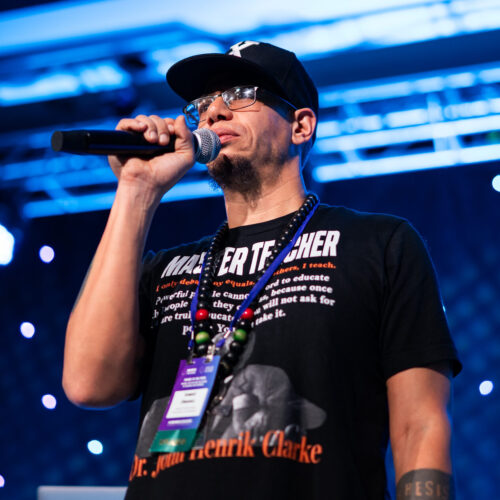
As I enter into my 45th year of life, I have been thinking about how little we actually know about this existence while being extremely confident that we understand it. Energy cannot be created or destroyed. The idea that we can even understand the beginning of the implications of that reality with total certainty is just game to me.
Life is a circle and I don’t believe it is only composed of what can be physically sensed. I don’t know exactly what that means, and I don’t feel a need to pretend that I do. I am not making an argument against science. Science has given human beings incredible ways of understanding the physical world. I question when we make the jump from that reality to believing what we can scientifically detect represents the boundaries of existence.
There were truths that existed before human beings developed instruments capable of detecting them. They didn’t suddenly become real when we figured out how to measure them. At the same time, I am not suggesting that because something is possible, it must be true. That is another type of foolishness. I just don’t understand why “we don’t currently know” is so difficult for people to sit with.
Rereading Jacob Carruthers’ Science and Oppression made me realize there is another problem underneath the one I was thinking about. Carruthers isn’t simply questioning the limitations of science. He is questioning the worldview that produced the methodology itself. His discussion of experimentation, classification, intervention and control pushed me to think about how methods of knowing don’t just appear out of nowhere. They come from people who already have ideas about nature, humanity, society and what knowledge is supposed to do.
I have always believed there is no such thing as pure objectivity. Folks claiming objectivity are still holding a subjective position. That doesn’t mean evidence doesn’t matter or that facts are whatever we want them to be. It means the person determining what counts as evidence is still a person. The categories came from somewhere. The questions came from somewhere. At some point you have to examine the house.
Land makes this pretty obvious to me. We talk about owning land like it is just a natural fact of human existence. Somebody buys a piece of the Earth and now it belongs to them. They can sell it, develop it, keep other people from using it and eventually give it to somebody else. We understand that because we have been educated into it. But can somebody really own something that existed millions of years before them and will hopefully be here long after they are gone? What happens if the relationship begins with responsibility instead of ownership? I don’t know the answer. I am more interested in how changing the question changes what becomes possible to think about.
This is part of why I have never believed European constructions of political economy represent the boundaries of human imagination. I don’t have some alternative economic system ready to roll out, but I believe the theorizing has to involve seriously understanding Indigenous cultures throughout Africa and the world. Not romanticizing people or pretending everything Indigenous is automatically good. But, understanding how people organized life when ownership, wealth, nature, spirituality and community didn’t necessarily begin with the same assumptions we inherited.
What possibilities disappear when one worldview gets to establish the definitions everybody else has to argue within? I deal with this constantly in education. We can add Black people to a curriculum without changing how the curriculum understands knowledge. That is one of the reasons I have never understood Black Studies as simply representation. Black people had to make sense of freedom while living inside their unfreedom, democracy while being excluded from it and Christianity while Christians were enslaving them. That struggle produced ways of understanding the world because people had to make sense of contradictions that the larger society had no interest in resolving.
Carruthers describes Black students as being caught between a “philosophy of liberation” and a “methodology of oppression.” I keep coming back to that because I see the same problem in a lot of what we call “transformation.” We change the content without examining the structure underneath it. A curriculum can have more Black people in it and still teach children to understand the world through the same old structure. That is not transformation to me.
I have seen enough in education to know that students don’t always receive knowledge in the neat ways adults plan for them to receive it either. Sometimes the question a young person asks exposes something about the lesson, the curriculum or even your own thinking that you hadn’t considered. The lesson for me has been that teaching isn’t only about what you know and give to students. You better be paying attention to what else they are seeing too. I have been thinking about the same problem with AI.
Everybody is worried about what AI can do, and that matters, but I am probably more interested in what it assumes. If you give a machine access to basically the whole recorded knowledge base but the architecture organizing that knowledge carries the same assumptions we already had, what exactly did we transform? If the categories are flawed, making the machine faster doesn’t resolve the problem. We can put AI in every classroom in America and still teach children to misunderstand themselves. We just figured out how to do it faster. That isn’t progress simply because the technology got better. It ain’t all good or getting better, and acting like it is creates confusion. More sophisticated technology doesn’t automatically mean we are more free. Advancement and liberation are not the same thing, although we seem to have gotten pretty comfortable treating them like they are.
If I am questioning the categories we inherited everywhere else, I have to question the separation between the spiritual and the rest of existence too. That separation has never made much sense to me anyway. I just want to do GOD’s will. However, it is arrogant to believe I could fathom exactly what that is. I can believe deeply in GOD while understanding that I don’t fully understand GOD. I can believe there is purpose without claiming I completely understand mine. That has probably become clearer through living more than anything else. Being in love, raising children, struggle, loss and simply watching people over time will complicate things you once thought you understood. Some things can make perfect sense conceptually until you actually have to live them.
Fatherhood is probably the clearest example for me. Fatherhood is not for the faint hearted. Raising children during these days and times makes it difficult to shield the babies from this wicked culture, but witnessing the growth and insights from your child brings hope to a dark situation. I have had moments when my children have said things that made me realize they were seeing something about the world I wasn’t thinking about at their age. What stays with me is the realization that I can give them what I know, but eventually they have to develop the ability to see for themselves. That might be one of the most important forms of education there is.
Being in love has taught me something about knowing too. I have said for years that being in love is the greatest gift that keeps giving. I understand that differently after actually building a life with my queen. There is no one disagreement or story that explains it because that isn’t really how it happened. It is the accumulation of life together. You learn that what makes perfect sense from where you are standing might look completely different from where somebody you love is standing. That doesn’t necessarily mean either person is lying or doesn’t understand. Sometimes you just aren’t seeing the whole thing.
Human beings know some things. We have developed incredible ways of knowing some things. I also have convictions that I stand on and don’t feel any need to apologize for having them. But none of that gives me reason to believe that what human beings currently know represents the totality of what can be known, or that the categories we inherited represent the only ways reality can be understood.
Carruthers made the question deeper for me because now I can’t only ask about the limits of the instrument. I have to think about the worldview that produced the instrument. And eventually I have to turn that same question back on myself. What am I seeing because I have learned how to see it, and what am I still unable to see because I don’t even know to look? I don’t know.
At 45, that doesn’t bother me nearly as much as it probably once did. I have convictions and I have questions. Both can exist. I just want to do GOD’s will with whatever time I have while understanding I am human enough not to fully comprehend what that means. Time is long, but life is short. It does not move linear, but overlaps. And whatever all of this is, I don’t believe what we can physically sense is the totality of it.