
“The South believed an educated Negro to be a dangerous Negro. And the South was not wholly wrong.” – W.E.B. Du Bois
These words have been a drumbeat in my work for a long time.
When my brother and comrade, Khari Shabazz, reaches for W.E.B. DuBois—“The South believed an educated Negro to be a dangerous Negro. And the South was not wholly wrong”— to help explain the situation of current Sixer and former Celtic, Jaylen Brown, he’s not just grabbing a strong and accurate quote. That line was in the bones of The Fellowship: Black Male Educators for Social Justice (BMEC) from the start.
Black men weren’t being gathered to be quiet classroom managers. The goal was to build up Black men educators as “dangerous” in DuBois’s sense: educated, intellectually sovereign, rooted in community, and ready to disrupt any school culture that demands obedience over justice. Jaylen Brown’s journey from Boston to Philly is another chapter in that same project—Black excellence linked to Black social power, whether the arena is a classroom, a court, or a city.
Those words also live in Khari’s recent reflection on Jaylen Brown and the Black mind. Khari lays out something this country keeps proving: Western civilization will cheer for a Black body, cash out on Black labor, and hype Black talent. But the minute a Black person becomes intellectually sovereign, historically grounded, deeply read, and unapologetic about thinking for themselves, they stop being a darling and start being a problem.
And then, as Mama Fasaha reminds us, the vocabulary shifts.
What used to be called “uppity Negro”—a Black person who refuses to accept a subordinate place in the social order—is now dressed up as “outspoken.” Same idea. Fresh coat of paint. The goal doesn’t change: signal that the Black mind is dangerous when it refuses to bow.
Jaylen Brown, “Outspoken,” and the New Code
In this country, people love to say “ball is life.” They tattoo it, hashtag it, raise children on it. But if ball is life, then something else is true too: racism is life in sports. From ownership boxes that still feel like plantations to hiring practices that sideline Black coaches and executives, from coded talk about “character” and “fit” to the way Black athletes get punished for having a mind of their own, the game is soaked in the same anti-Blackness found in schools, courts, and boardrooms.
In 2026, the Boston Celtics traded Jaylen Brown—world champion, 2024 Finals MVP, multiple-time All-Star, one of the top players on earth—to the Philadelphia 76ers for Paul George and future picks. On the surface, people will say it’s just basketball: contracts, cap space, numbers, another big move in a busy offseason.
But listen to the way people talk about Jaylen off the box score.
It’s not only points, defense, efficiency. It’s comments about him “thinking he’s the smartest man in the room,” being “too much,” having ideas that “get in the way.” He is painted as a problem, not because he can’t hoop, but because he can think.
Khari names that straight: Jaylen wasn’t moved because his work product fell off. He was moved because he is a dark-skinned intellectual whose ideas stretch beyond professional basketball. He reads. He studies history. He speaks on labor, power, and Black folks. He wants more for his people than sneaker deals and highlight reels. That kind of Black mind keeps white-dominated institutions nervous.
Under that nervousness, “outspoken” becomes a warning sign.
It’s not “uppity Negro,” but it’s doing the same job.
“I Made You Affluent”: Ownership As Obedience
Khari doesn’t just talk about ball. He tells on the school world, too.
As a principal, he joined a group of Black, Brown, and white school leaders to boycott a gala they believed carried white supremacist overtones. They took a stand. They got caught. Khari was called into an office on Wall Street, sat down, scolded, and told, “I made you affluent.”
That line wasn’t about the size of his paycheck.
It was about ownership. It was a reminder that someone believed they had bought not only his labor but his loyalty. It was the quiet expectation that independence comes with a leash. Institutions want the work, yes—but they also want obedience. And when those institutions are steeped in whiteness, they expect Black workers to be the most obedient of all.
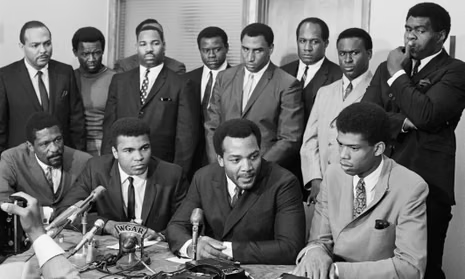
DuBois warned that an educated Negro would be seen as dangerous. Jim Brown understood that when he refused to stay in his lane and used his platform for organizing. Muhammad Ali understood it when he chose conscience over comfort, titles, and public approval. Tommie Smith and John Carlos understood it when they stepped onto the Olympic podium in Mexico City, raised black-gloved fists, bowed their heads, and accepted exile for telling the truth about Black suffering and U.S. hypocrisy. Those brothers, and the other Black athletes in those photos, knew there would be a price.
Jaylen Brown stands in that same tradition of refusing to behave.
Who Gets To Define “Good” For Black Kids?
This dynamic isn’t just about sports. It shows up in the education “reform” world too. There are commentators and policy folks who have built careers warning that schools have become “obsessed with race,” mocking antiracism, and insisting that talking honestly about racism will somehow harm children. At the same time, they write from and defend systems that have always been racialized—tracking, suspensions, special education placements, funding, discipline—all of it.
If Black education leaders don’t run schools the way those folks want, if they refuse a script built on control and contempt for Black families, they get painted as the problem. But, the truth is, so many of the Black educators I have been blessed to work with love Black communities and feel led by them. They see families as partners, not targets. They imagine schools as sacred places, not white savior factories. They are not trying to strip race out of the conversation; they are trying to strip anti-Blackness out of the practice.
And that terrifies people who built their whole identity on being the ones who define “good” for Black kids. And, when Black folks challenge their too often myopic views of the full dimensions of Black humanity, intellectualism, and creativity and boldly voice their allegiance to Black communities, they are viewed as uppity, too-smart-for-their-own-good, ungrateful for the opportunity to serve their communities, and unworthy of leadership too.
Philly, Fragility, And The Hope Of Team
Mama Fasaha comes at it like a Sixers fan who has seen some things.
She calls the trade “mind-boggling,” not just because Boston took less than people expected for a player of Jaylen’s caliber, but because it fits a pattern: Black excellence that won’t lower its eyes gets labeled a problem and pushed out.
She says 2026 America has simply swapped “uppity Negro” for “outspoken.” Then she turns to hope. Her hope is that Jaylen can help the Sixers grow from “a collection of pieces” into an actual team—despite Joel Embiid’s brittleness and owners who seem more interested in bragging rights than in building something they truly care about.
That vision goes beyond banners and parades.
It’s about what happens when a Black athlete with a serious mind enters a franchise that has struggled with clear leadership and real purpose. It’s about whether the Sixers, and this city wrapped around them, can embrace a Black man who brings his intellect and his politics to work every day, not just his jump shot.
Mama Fasaha says, You do that, Jaylen Brown—come in here, help form a serious squad, hold teammates accountable, and refuse the “just play” script—and people in Philly will forget that Celtics green faster than a missed free throw in May.
“Shut Up And Dribble” Without Saying It
Here’s the thing: nobody has to say “shut up and dribble” out loud anymore.
The message got slick.
Now it shows up as “he’s a distraction,” “he’s too outspoken,” “he’s hard to coach,” “he doesn’t understand his role,” “he’s making it about more than basketball.” Same demand, dressed up: perform, entertain, produce revenue—but tone down your mind, your reading, your politics, your organizing. We want your body, not your mind or mouth unless it is, of course, serving us, entertaining us.
Khari refuses that in the world of schools and nonprofit work. Mama Fasaha refuses it as a Black thinker and fan who hears exactly what these words are doing. Jaylen Brown refuses it every time he lets his intellect, his analysis, and his commitments travel with him into the locker room, the media scrum, and the city that just traded for him.
“I Am Not Your Negro”
James Baldwin told white America it needed to ask itself why it ever needed a “nigger” in the first place, because he was not a nigger—he was a man—and that invention said more about their need than about his humanity. In their own lanes, Khari and Jaylen are carrying that same refusal. They are saying, through how they move: I am not your Negro, not your boy, not your purchase. I bring my full Black mind to this work, and if that scares somebody, that fear belongs to them.
That’s why this trade isn’t just a roster move – it is a mirror.
The question isn’t only whether the Sixers can win with Jaylen Brown. The question is whether Philadelphia—its schools, its movements, its institutions, its everyday Black folks—will embrace Black excellence that comes with a sharp mind and a backbone, not just a highlight reel.
Will “outspoken” become the new way of punishing a Black mind that refuses second-class status?
Or will this city, and this moment, show that there is room for Black brilliance that refuses to bow—on the court, in the classroom, and everywhere else Black people show up?
Nobody has to say “shut up and dribble” anymore.
The expectation is still there.
The work—for those who know what they’re looking at—is to recognize it, call it out, and stand next to the people who refuse it.
Excellent piece!