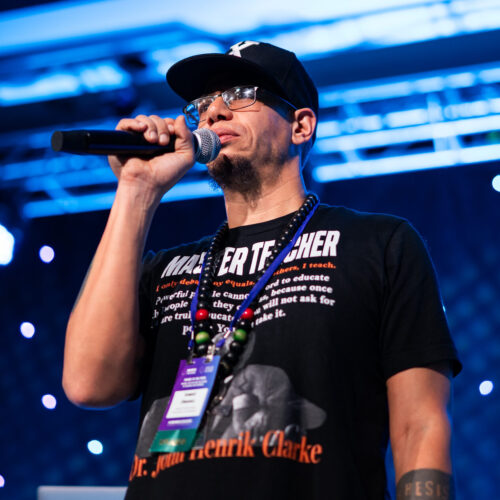

My mother introduced me to conversations about racism, injustice, power, and the contradictions of American society when I was still young. A lot of the lessons she passed down came from protection and love. Work hard. Learn how the world operates. Carry yourself with discipline. Be careful. Understand how quickly Black children can be reduced in the eyes of a society already waiting to misrecognize them.
As a child, I remember sensing tension between survival and freedom, even if I could not yet articulate it clearly. Something about the conversation always seemed incomplete. The closer the discussion moved toward “making it,” the more success seemed tied to proximity. Closer to institutions. Closer to wealth. Closer to whiteness. Closer to forms of legitimacy already defined by a society that had historically struggled to recognize Black humanity outside of labor, entertainment, service, or controlled inclusion. It felt like we were constantly being trained to become internal to systems that remained fundamentally external to us.
Over time, I realized how much energy Black people spend translating ourselves into language that dominant institutions can tolerate without becoming too uncomfortable. Liberation becomes equity. Structural critique becomes diversity language. Historical trauma becomes achievement gaps and opportunity gaps because those phrases feel safer inside institutional spaces. Something vital gets lost in the transaction. We are paying a translation tax that leaves us intellectually bankrupt.
Part of what has stayed with me over the years is the realization that the wounds Black people carry were never only economic wounds. They were psychological. Spiritual. Cultural. Historical. You can diversify institutions or create inclusion initiatives and still leave those wounds untouched. We are funding a clinic while the air remains poisoned.
Becoming an educator became my response to that tension. At some deep level, I believed education could become a space where Black children encountered themselves differently than the world often teaches them to. I wanted students to wrestle with questions beyond career readiness and social mobility. I wanted them to encounter history as something alive inside them, not something distant and disconnected from their present reality.
That is ultimately what led me toward Africana Studies. What struck me immediately was that Africana Studies was not simply offering more content. It was offering a different vantage point altogether. I had spent time wrestling inside Marxist spaces and other radical traditions that helped me critique capitalism and power, but I often left those spaces feeling like something essential about the Black condition remained unresolved. Anti-Blackness was flattened into class analysis or treated as secondary to larger economic contradictions. And eventually I realized that even many critiques of the house were still being written by people who owned the blueprints. I needed a framework that began outside the house altogether.
Africana Studies pushed me to think seriously about worldviews are defined. How Eurocentric assumptions shape not only institutions, but consciousness. How definitions of intelligence, success, order, and humanity become normalized until people begin mistaking adaptation to oppressive systems for liberation from them. And once you begin wrestling seriously with those questions, it becomes difficult to move comfortably through many mainstream conversations about Black advancement.
After almost two decades in education, I have watched institutions become increasingly fluent in the language of equity while remaining deeply constrained in their imagination. I have watched culturally responsive teaching become flattened into surface-level inclusion while the deeper assumptions about knowledge, achievement, professionalism, and value remain untouched. Sometimes it feels like we are teaching Black children how to become highly functional inside systems that still depend upon their containment.
A “successful” student learns how to navigate the maze, but the sovereign mind begins questioning why the maze exists at all. That distinction matters to me more now than ever before. The attacks on Black Studies. The fear around honest discussions of race and history. The language of “reverse discrimination.” The retreat from DEI initiatives the moment they begin unsettling deeper structures of power. At some point, you stop seeing these moments as isolated events. You start recognizing the pattern. Reconstruction gives way to Redemption. The Great Migration gives way to redlining. Civil Rights gives way to mass incarceration. Diversity initiatives give way to anti-DEI backlash.
The rollback is not accidental. Progress in America often functions through a breathe-and-squeeze rhythm. Limited expansion followed by containment. Inclusion followed by retrenchment. That realization pushed me back toward Derrick Bell in a deeper way. Bell forced us to confront the possibility that much of what America calls racial progress remains conditional. Rights are tolerated when they converge with broader institutional interests and narrowed when they threaten the deeper architecture of power. Honestly, that realization carries grief with it.
Many of us were taught to believe progress was a floor steadily being built beneath us. But more and more, it feels like that floor was often just a temporary rug that could be pulled back the moment the society felt too unsettled by the implications of genuine transformation. That is why I keep returning to the phrase “survival pending revolution” from the Black Panther Party.
What stays with me now is the word pending. The Panthers understood survival programs mattered because people matter. Children need food. Communities need healthcare. People need political education and institutional support. But survival was never supposed to become the destination. The waiting room was not the home. And I worry that in our current moment, we have quietly abandoned the second half of the phrase. We still practice survival. We still pursue representation, entrepreneurship, inclusion, visibility, and access. But increasingly, it feels like we have mistaken managed inclusion for liberation itself.
I support Black businesses.
I support targeted investments in Black communities and schools.
I support financial literacy because economic vulnerability has always been weaponized against Black people.
I support Black leadership rooted in genuine historical and political consciousness.
I also think we need to be honest about the limits of survival programs when they remain trapped inside Eurocentric assumptions about success and freedom. If the only version of liberation we offer our children is the opportunity to compete for a higher position within structures that still fundamentally distort their humanity, then we have not freed them. We have simply refined their shackles.
I realize now that my mother’s lessons were the floor, but they were never meant to become the ceiling. We have become masters of the floor of survival, discipline, professionalism, and navigation. But the “pending” in the Panthers’ vision was always an invitation to look beyond survival itself. And maybe that is the deeper responsibility of education.
Not simply preparing Black children to make it through systems that are continuously unmaking them, but helping them recover enough historical clarity and radical imagination to conceive of life beyond the conceptual limits this society continuously imposes upon them. Because liberation cannot simply mean becoming more comfortable inside the house. At some point, we have to remember how to build differently altogether.