

Malcolm X’s birthday should make Black school leaders sit with a difficult question. Not simply whether or not we have enough Black principals, but whether Black children are more free, literate, confident, protected, historically-grounded, and more powerful because those Black principals are leading.
Malcolm would not applaud Black faces managing anti-Black systems. He would not confuse representation with liberation. He would not mistake access to the principal’s chair for freedom. He would ask what Black principals are doing with the power they have.
And he would begin with love.
In The Ballot or the Bullet, Malcolm said, “We have to change our own minds about each other. We have to see each other with new eyes. We have to see each other as brothers and sisters.” That is not just a political charge. It is a school leadership mandate.
Black principals cannot serve Black children and their families well if they do not see them as kin and kindred. And we have to be clear: all skinfolk ain’t kinfolk, and all kinfolk ain’t kindred. Black leadership requires more than shared racial identity. It requires an orientation toward the people we serve, a commitment to seeing our children as the ones who will replace us in the world, better, stronger, more equipped, and more effective.
Malcolm’s fire was never contempt for our people. It was love sharpened into responsibility. So on his birthday, the questions are: Black principals for what? Black principals for whom? Black principals accountable to whom?
Community Control, Not Symbolic Diversity
In his speech at the Organization of Afro-American Unity (OAAU) founding rally, Malcolm called for 10 percent of schools in Harlem and Bedford-Stuyvesant, that the Board of Education demonstrated that it could not improve, to be turned over to the Black community. He wanted Black principals, Black teachers, Black-authored textbooks, community influence over school boards, and parents fully involved in the life of the school.
Malcolm was not merely asking for a Black person to sit in the chair. He was asking who controlled the school, whose knowledge shaped the curriculum, whose parents were trusted, and whose community had the power to define whether the school was worthy of its children.
Nationally, Black educators make up around 10 percent of public K-12 principals. But Malcolm would not stop at the percentage. He would ask what those principals believe, whom they love, whom they listen to, and what kind of schools they are building.
A Black principal who leads through the same logic as white supremacy is not the answer. If they criminalize Black children, silence Black parents, erase Black history, punish Black language, or treat poor and working-class families as problems to manage, they are administering somebody else’s project.
The Truth About The “Passport” Quote
People love to quote Malcolm as saying, “Education is our passport to the future.” But too many people stop there because the full quote is more demanding.
In the OAAU speech, Malcolm said, “Education is an important element in the struggle for human rights. It is the means to help our children and our people rediscover their identity and thereby increase their self-respect. Education is our passport to the future, for tomorrow belongs only to the people who prepare for it today.”
That is the assignment.
Malcolm was not talking about education as a private ladder into the middle class. He was talking about education as a collective instrument for identity, self-respect, preparation, power, and human rights.
So if Black principals are not grounded in Black history, African diasporic memory, Black political thought, and Afrofuturist imagination, they can still fail Black children while standing in front of them with a Black face. The passport is not just a diploma, college admission, or career readiness. The passport is preparation for freedom.
That is why the Black Panther Party’s education demand belongs in this conversation. In Point 5 of the Party’s Ten-Point Program, the Panthers demanded education that exposed the true nature of society, taught Black people our true history, and clarified our role in the present day. That is Malcolm’s passport quote with institutional teeth.
The Panthers understood themselves in Malcolm’s lineage, as sons and children of Malcolm who carried self-determination into organized community action. That lineage reminds us that education was never separate from freedom work.
A school that refuses to teach Black children their true history cannot be called “rigorous.” A school that does not help children understand their role in changing the present is preparing them to be governed by people have already determined their role in society. This is reflected when people make the claim that our children are destined to “flip pizza crusts”, or when a lawyer for Senate President Pro Tempore Jake Corman asked, “What use would someone on the McDonald’s career track have for Algebra 1?” adding that “there’s a need for retail workers, for people who know how to flip a pizza crust.”
Anti-Blackness In, Anti-Blackness Out
Malcolm would press Black principals on class, contempt, and consciousness. He demanded discipline, study, self-respect, organization, sacrifice, and transformation. But his high bar was not contempt. It was love with expectations, not the “pound cake” style of browbeating Black people, talking down to parents, or confusing shaming with leadership. This is less about a salary chasm than the class wars our enemies want us to wage against one another.
Still, we should name the distance that can exist. While salaries can vary greatly, NCES reported the average public school principal salary at $105,900 in 2020-21, and $104,100 in schools where 75 percent or more of students were approved for free or reduced-price lunch. That meal-status measure is imperfect, but NCES notes it generally includes students in households below 185 percent of the poverty threshold, and the 2025-26 guidelines put a family of four at $41,795 for free meals and $59,478 for reduced-price meals. Schools with 75 percent or more students approved for free or reduced-price lunch are also far more likely to have Black principals than low-poverty schools: 18.4 percent compared with 3.6 percent. That context matters because class distance, if left unexamined, can become contempt.
Black principals must avoid using titles, degrees, professional vocabulary, or proximity to systems to look down on the families we are called to serve. Educators who reach first for holding parents accountable often need deeper soul-searching about whether our schools are welcoming, transparent, and worthy partners. Our role is not to shame families into compliance. It is to build the systems of support, trust, transparency, and partnership our parents and children deserve.
There is also a different orientation between schools “having a community” and understanding that they are inside of a community. The first turns community into an accessory to invite in when the school needs buy-in. The second sees parents, neighbors, elders, students, educators, and principals as part of one ecosystem of memory, care, protection, teaching, and struggle. In that spirit, school communities need principals as quiet connectors and parents as agitators, each investing in relationships and building the learning communities our young people require.
Some Black educators may have found their Blackness late. That is not a sin. Many of us come to consciousness through study, struggle, relationships, and experience. The danger is finding Blackness as identity but never developing love for Black people as we actually are. A principal can share ancestry but not humility. They may match in racial identity but still clutch pearls at Black poverty, Black language, Black anger, Black parents, Black joy, and Black refusal.
Malcolm’s “Who taught you to hate yourself?” challenge still belongs in schools. Applied to school leadership, the question becomes: who taught Black educators to look at Black children, Black parents, Black poverty, Black neighborhoods, and Black language with contempt?
Anti-Blackness comes in through adult assumptions and comes out as discipline disparities. It comes in through low expectations and comes out as remedial tracks. It comes in through fear of Black children and comes out as surveillance. It comes in through contempt for Black families and comes out as faux “engagement strategies” that avoid, blame, or manage them.
Malcolm would command us to burn the belief that being detached from families is excellence, that being removed from the people makes you more professional, that class mobility makes you morally superior, and that the “best” Black people are those who escaped the neighborhood rather than those who remained accountable to it.
Carter G. Woodson warned that miseducation could produce formally educated Black people with contempt for their own people. Du Bois’s own thinking also moved beyond a narrow elite rescue fantasy; later reflections on the “talented tenth” worried about self-indulgent, well-to-do leaders more concerned with their own advancement than the masses.
Malcolm would recognize that degrees without consciousness are not liberation, and credentials without love are not leadership. He would have no patience for educators who march online to disparage Black children, whether loudly or quietly, directly or through coded language. Public cynicism about Black children is not brave honesty. It is obedience to the system.
Chris Stewart, Ismael Jimenez, and I talked about this on a recent Freedom Friday podcast episode titled “Not Everyone Should Teach Black Children”. Educators may leave for myriad reasons. The work is hard. The conditions can be brutal. But if you must leave, do not set fire to children on your way out the door. Black principals should refuse a staff culture where adults process frustration by disparaging the very children they were hired to serve.
By Any Means Necessary Means Mitigating Harm
As a young student, Malcolm wanted to become a lawyer, but his teacher told him that was not realistic for a Black child and pushed him toward carpentry instead. That moment shows what racial injustice can sound like from an educator: lowered expectations disguised as realism.
Malcolm would not excuse Black principals who reproduce that harm simply because they are Black. If a principal looks down on students because they are poor, their language is not “middle-class,” or their pain shows up in ways school finds inconvenient, that principal is participating in the same miseducation Malcolm fought.
This is why “by any means necessary” has to start and end with educational and racial justice.
In schools, that means using every tool in the principalship to reduce harm and accelerate outcomes. Move the strongest teachers to the children who need them most. Don’t allow weak instruction to hide behind seniority or politeness. Confront discipline patterns. Fight for resources. Build tutoring systems. Protect Black teachers. Listen to parents. Make sure Black children are not merely surviving school, but becoming stronger because of it.
Baba Changa taught us early that you can defend the truth physically and intellectually. That lesson was never only about martial arts. It was about whether you would stand between your people and harm, tell the truth, and act when action was required. Some principals missed that message. Others take it head on and embody it.
Feed Bellies, Brains, and Aspirations
When the Black Panther Party ran a free breakfast program for children. The government saw it as a threat. That fear was never just about breakfast; it was about influence, organization, and Black communities meeting Black children’s needs without permission. Hoover’s obsession with the Panthers reminds us how dangerous Black care can look to a system built on Black deprivation.
If feeding Black children’s bellies was viewed as a threat, imagine what a committed, systemic Black school leadership project could do if it fed their bellies, brains, identities, and aspirations. Imagine principals treating breakfast, literacy, mathematics, history, science, art, political clarity, physical safety, and future-building as one freedom project. We might actually get a revolution.
A school that feeds a child and then starves their mind is not a school Malcolm would support. A school that accelerates test scores while humiliating Black children, or teaches them to read but not recognize their power isn’t either.
Black Principals Are Multipliers
Research backs up what Malcolm would have known instinctively: effective principals shape achievement, attendance, teacher satisfaction, and retention, while Black principals help increase Black teacher hiring and retention and improve Black students’ math achievement.
Black principals face a related tension: the work is mission-driven, but too often made unsustainable. Research on Black principals names racialized resistance, isolation, and workload as forces that can shorten planned tenure, while broader principal-turnover research shows churn is highest in high-poverty schools and harms student achievement, teacher retention, and school climate.
Black principals can change the adult ecosystem around Black children. One study of Missouri and Tennessee found that switching from a white to a Black principal increased the share of Black teachers after five years by about 5 percentage points. Newer reporting on New York City found Black teachers were significantly more likely to stay when they worked with a Black principal and a critical mass of Black colleagues, with Black principal leadership reducing Black teacher turnover by about 14 percent from 2011 to 2020.
That matters because Black teachers change outcomes for Black children. Johns Hopkins researchers reported that low-income Black students with at least one Black teacher in elementary school were more likely to graduate from high school and consider college.
If Black teachers change the life trajectory of Black children, then Black principals help decide whether that power enters and stays in the building. They can recruit, protect, develop, and retain Black teachers, creating conditions where Black children are surrounded by adults who see their brilliance without needing it translated. That is “by any means necessary” in administrative form.
Recruiting Black teachers is not enough if the school culture harms them once they arrive. A recent Ed Trust report, If You Listen, We Will Stay, names what too many teachers of color experience: antagonistic cultures, feeling undervalued, being deprived of agency and autonomy, unfavorable working conditions, and the high cost of being teachers of color.
Black educators often carry deep hope even under hostile conditions: 85 percent of Black teachers reported planning to stay in the classroom for their whole career, even as Black teachers face higher turnover than white peers. Black teachers have the highest job-related morale while also facing pressures that can push them out before they are ready.
To Be Who We Are, the Teach Plus and Center for Black Educator Development report rooted in the voices of more than 100 Black educators, pushes the same truth: supporting and retaining Black teachers requires transforming school culture, not merely recruiting Black educators into hostile environments.
Listening is not a courtesy. It is an achievement, retention, and justice strategy.
Research on teacher leadership also shows that schools with stronger teacher and instructional leadership have higher student achievement, and that teacher voice in discipline procedures and school improvement planning matters. Black principals who claim Malcolm’s mantle must ask whether Black teachers have real voice in discipline, school improvement, curriculum, culture, and leadership pathways.
If we listen, more will stay. If more stay, children benefit. If children benefit, Malcolm’s vision moves from speech to structure.
Spiritual Leadership Is Servant Leadership
Malcolm would remind Black principals that leadership is ultimately spiritual.
Not performative piety. Not respectability religion. Not using faith language to avoid hard truths. Spiritual leadership means being disciplined by purpose, humbled by responsibility, and accountable to something larger than ego, title, career, or applause.
Ella Baker modeled this. In her Freedom Day Rally speech, Baker rooted the work in a cause larger than any organization and in “the drive of the human spirit for freedom.” Her leadership was not about becoming the face of the movement. It was about developing people, building collective power, and helping ordinary people understand what they could do together.
That is the spiritual posture Black principalship needs. Less ego. More service. Less performance. More courage. Less control. More development. Less saviorism. More solidarity.
Suppose every principal certification program was grounded in Ella Baker’s model. Imagine aspiring principals trained first as listeners, organizers, community servants, and builders of collective power, not merely as managers of compliance. Imagine reflection practiced with candid feedback from students, families, teachers, and community, not alone after harm has already occurred.
Reflecting without feedback should be limited. Listening to feedback, hearing it, and implementing it is far more powerful than reflecting without the people who experience your leadership.
The principal is not the source of liberation. The principal stewards conditions where children, families, and educators can discover and exercise their own power.
Black Principalship as a 100-Year Plan
Malcolm would not treat Black principalship as a short-term staffing initiative. He would see it as part of a 100-year freedom plan. The best time to build that plan was yesterday. The next best time is now.
That means Black principalship cannot be reduced to filling vacancies, improving climate scores, or surviving district mandates. Every Black principal should ask who they are developing, protecting, and preparing, and what kind of leadership will remain after they leave.
This is not abstract. We have models of Black principalship at its best. Salome Thomas-El and Hilderbrand Pelzer III were two Black male principals who impacted Black boys and a future Black principal. Principal El covered my school when I was arrested for being a Black Muslim attending an anti-war protest, and both he and Pelzer gave me space, guidance, friendship, and mentorship as a young Black male educator learning to lead.
Yvonne Savior modeled that too. She was an absolute legend of an educator who taught me how to be firm in conviction, adaptable in tactics, and how to approach the work as a servant leader committed to educational and racial justice.
Before I ever had a principal title, I saw this in Mama Fasaha Traylor at Nidhamu Sasa. She represented Black educational leadership rooted in community, identity, discipline, history, and love. Nidhamu Sasa taught us that education was not just preparation for school success. It was preparation for struggle, self-knowledge, service, and freedom.
I learned that same accountability alongside peers and colleagues like Chris Johnson, Aaron Starke, Sheila Mallory, and our beloved late Miles Wilson. We had supervisors and managers, but our first accountability began with parents, children, and the staff we served.
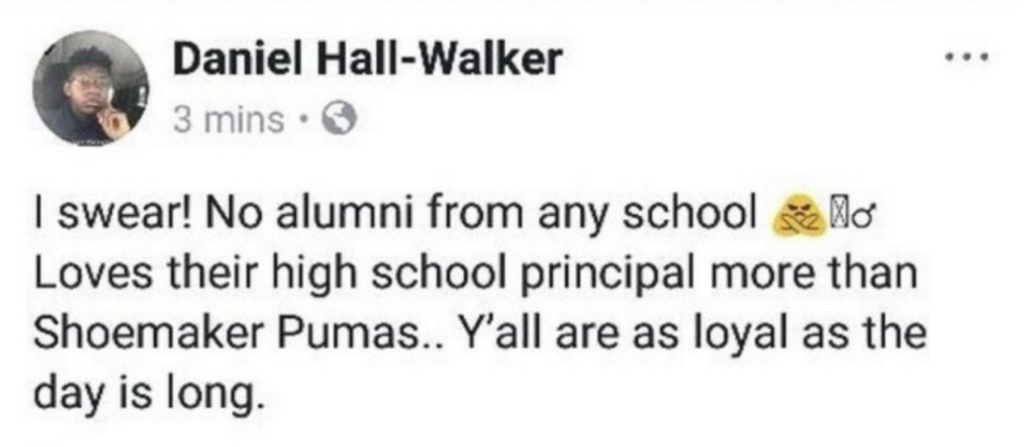
That kind of leadership leaves evidence in people. A young man I did not know once posted, “I swear! No alumni from any school loves their high school principal more than Shoemaker Pumas. Y’all are as loyal as the day is long.” That was humbling and joyful because it named what data alone cannot always capture: trust, memory, and a school community still bound to its people.
Principals should want that kind of testimony, not for ego, but as a part of the feedback loop, but it cannot stop at tweets. Years later, do students remember being loved, respected, challenged, and refused to be given up on? Do they remember a school that made them proud of who they were and serious about who they could become?
If the answer is yes, that is part of the work Malcolm was calling us toward.
What We Owe
As an ancestor, Malcolm did us proud. He studied, changed, grew, risked, organized, taught, loved, and told the truth with a courage that still reaches us. He did not leave us comfort. He left us responsibility. Black principals should follow his legacy and ask hard questions: What do we owe our ancestors, and what do we owe our descendants, when we are entrusted with school leadership?
We owe our ancestors more than admiration. We owe them schools that do not betray their struggle, children who know their names and understand the systems they fought, and the refusal to let Black education become a polite machinery for forgetting.
We owe our descendants more than survival stories. We owe them institutions, habits, literacies, memories, relationships, and leadership models that make them freer than we were. We owe them schools that prepare them to recognize danger, build power, love their people, govern their futures, and refuse every system that tries to make them small.
Black leaders must prepare our youth for their future. They must also prepare them to replace us, not as replicas of our limitations, but as leaders better equipped, stronger, and more effective than the systems that tried to contain us ever intended.
Yes, the moral arc of the universe may bend toward justice. But Black principals should not stand around admiring that arc. The most effective ones bring a hammer: lesson plans, master schedules, budgets, coaching cycles, family meetings, restorative systems, reading interventions, Black history, teacher pipelines, and community accountability to speed the bending along.
The purest form of activism for a Black principal is building a school where Black children are safe, loved, literate, numerate, historically grounded, politically conscious, and academically accelerated.
“By any means necessary” must start and end there.

Magnificent.
This article was immensely powerful. It must serve as a call to arms in service of liberation and education. In reflecting on the words of truth from Malcolm, Bro. Sharif has ignited a Conspiracy of Care! When Black Principals, their faculties and community unite under the banner of authentic education not marginalized schooling, our children will aspire and excel. Onward and upward!!!